Translated from Albanian · Original article in Albanian →
Accusations, labelling and public exposure at the height of the protests. Who verifies the claims and who bears responsibility for the consequences?
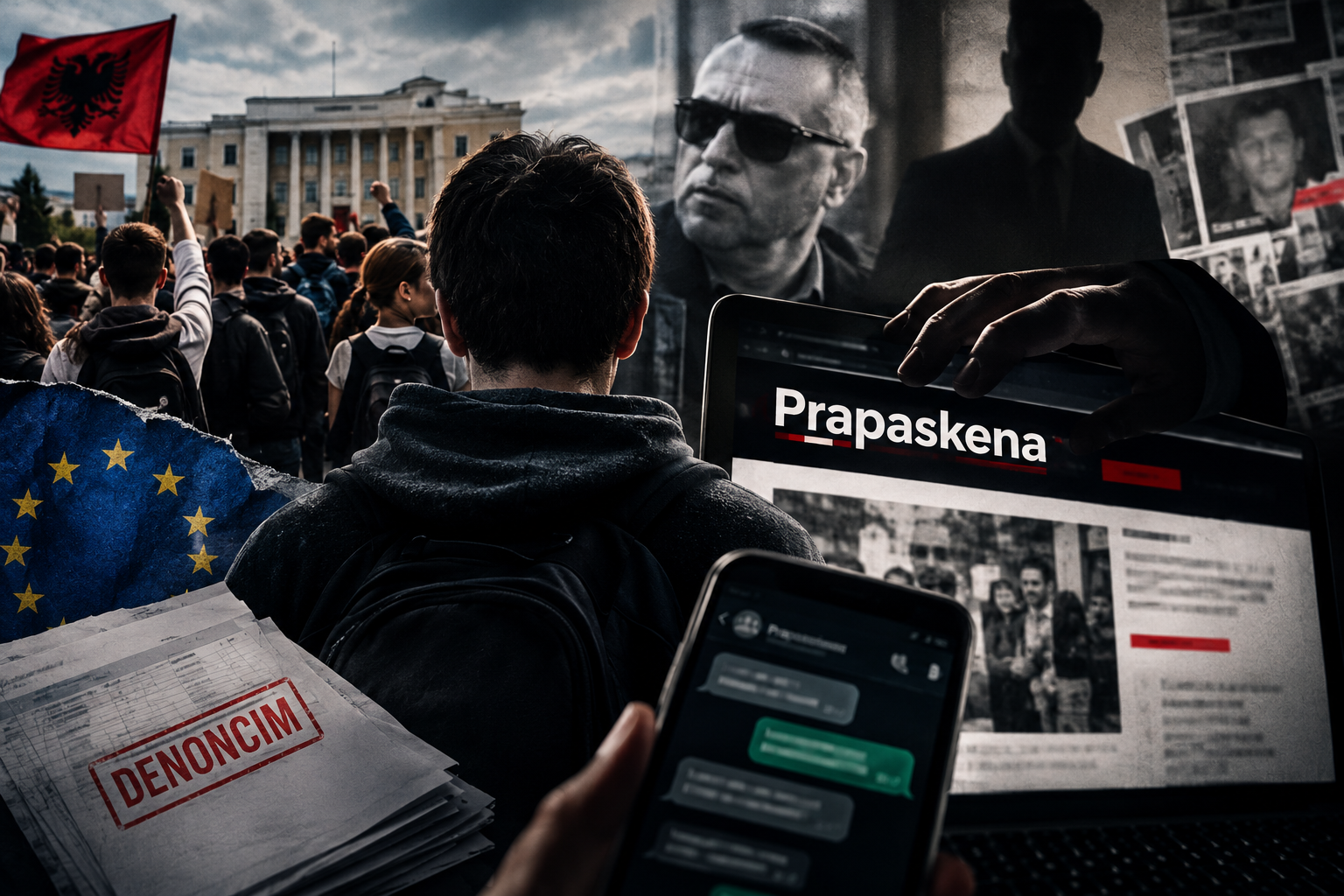
At a time when students and citizens have taken to the streets to oppose the government, the Prapaskena portal has published an article claiming to identify people linked to a group planning acts of violence in Tiranë. The article focuses on Irini Myftaraj and on messages that, according to the outlet, are connected to violent actions against businesses and banks.
But precisely when the situation is tense, a fundamental question arises: where does informing the public end, and where does the risk of publicly labelling individuals before the claims are proven begin?
If authentic messages exist that document concrete plans for violence, they must be verified and dealt with by the competent authorities. Violence against citizens, businesses or institutions is not justified by any political cause.
But no media outlet can replace the justice system. A sensational headline is not a court ruling, and a claim published online is not sufficient evidence to declare someone guilty.
Prapaskena and its history of attacks on critical voices
Concerns about the way Prapaskena treats journalists, researchers and critical voices are not new.
In October 2024, the European Federation of Journalists and partner organisations condemned smear campaigns against civil society organisations and the researcher Blerjana Bino. In their statement, they also mentioned publications by Prapaskena.com that had targeted Bino and independent organisations.
In July 2026, the SafeJournalists network documented a series of Prapaskena publications targeting News24 journalists, using derogatory labels and questioning their professional integrity without presenting evidence for some of the claims made. According to the organisation, these publications contributed to a hostile environment for journalists.
These are criticisms documented by organisations that monitor media freedom, not merely accusations thrown around on social media.
Sources:
- European Federation of Journalists: https://europeanjournalists.org/blog/2024/10/08/albania-smear-campaigns-against-independent-media-and-civil-society-organisations-must-stop/
- SafeJournalists: https://safejournalists.net/incident/other-threats-to-news24-journalists-05-07-2026-tirana/
Carlo Bollino and the questions over ownership
Carlo Bollino’s name has been mentioned in public debates about the ownership of Prapaskena. In February 2023, CNA reported that Bollino had denied being the owner of the portal, describing the claims as defamation.
Therefore, any claim that he is behind the portal must be supported by ownership documents, business registration data or other verifiable evidence. The ownership or control of a media outlet cannot be declared a fact simply by repeating an accusation.
Nevertheless, questions about the real ownership of media outlets, their sources of funding, possible conflicts of interest and their relations with those in power are legitimate matters of public interest.
Source: https://www.cna.al/aktualitet/carlo-bollino-po-me-ojne-per-prapaskenen-e-gjobave-i349665
Students cannot be judged by headlines
Albania does not need a climate in which every protester can be portrayed as a criminal and every critic of the government treated as a threat.
If someone is planning to attack a bank, destroy a business or commit violence, there must be an investigation, evidence and legal accountability. But if a person is publicly identified through messages published by a portal, the public has the right to know whether those messages are authentic, how they were obtained and whether they have been independently verified.
This is especially important when it comes to young people, students and citizens taking part in protests.
The right to protest is not a licence for violence. But neither is presence at a protest proof of involvement in criminal activity.
Questions that demand answers
Prapaskena must answer the questions raised by publications of this kind:
- Have the published messages been independently verified?
- Was the identified person contacted to give their side of the story?
- Was a distinction made between taking part in a protest and being suspected of preparing a criminal offence?
- Was complete evidence presented, or only fragments that support a particular narrative?
- Who really owns and funds the portal, and is this information transparent?
These are not questions meant to defend violence. They are questions meant to defend the minimum standards of journalism.
Media freedom is not immunity from criticism
A media outlet may criticise protesters, publish investigations and expose suspected criminal plans. But the public has the same right to scrutinise its sources, interests and methodology.
Reports by media freedom organisations show that personal attacks and smear campaigns are a real concern in Albania. This does not mean that every Prapaskena article is untrue. It means that claims of breaches of journalistic standards must be examined with evidence, just like the claims the outlet makes against others.
In the end, the issue is not whether a portal likes a protest or not. The issue is whether it informs the public with verifiable evidence, respects the right of reply and distinguishes fact from accusation.
Because when a headline turns into a public sentence, the damage to a citizen can be done before the justice system has had its say. And responsibility for this cannot hide behind the word “journalism”.
PasPerdes.com will continue to demand transparency from those in power, but also from media outlets that claim to speak in the name of truth.